 By 變美體驗官
When it comes to getting cosmetic treatments in South Korea, one of the most common pieces of advice is to “find a clinic with a red mark.” But what exactly is this red mark? What’s the difference between clinics with a red mark and regular Dermatology clinics in South Korea? And why do some say there’s a huge difference between them?
Let’s be straight up: what’s meant by the “red label” is a certification indicating that a doctor is a specialist in Dermatology. In regular Dermatology clinics, the doctors might be those who switched from other specialties or focus only on basic cosmetic treatments. There are indeed significant differences between the two in terms of years of training, ability to handle complex cases, and expertise in managing complications. But—having a red label doesn’t guarantee everything will go smoothly, and regular clinics aren’t necessarily inferior either. We’ll clarify these differences below and show you how to make the right choice without running into problems.
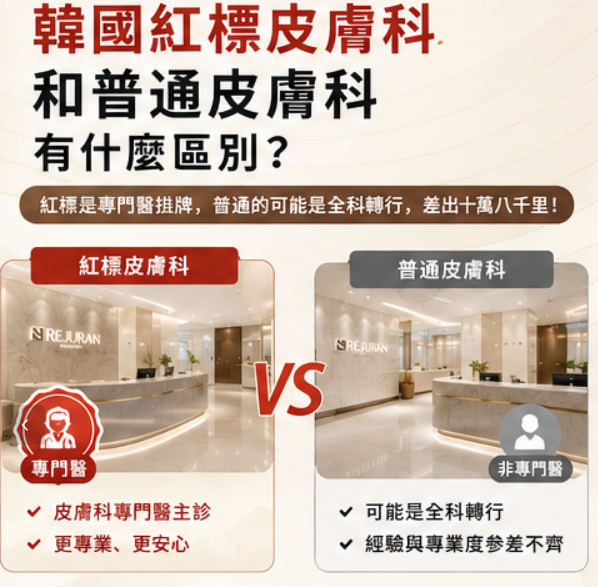
I. The most fundamental difference: one is a “specialist doctor,” while the other might just be someone who “knows how to give injections.”
The full name of the red badge is “Dermatology Specialist (피부과 전문의)”, issued by the Korean Association of Dermatologists (AKD). It signifies that the doctor has completed comprehensive specialized training in Dermatology, having studied and passed exams in skin pathology, laser procedures, and complication management.
Regular Dermatology clinics don’t offer such guarantees. While the standards for obtaining a medical license in South Korea are quite high, having a medical license is not the same as being a board-certified dermatologist. Some doctors at clinics come from fields like internal medicine or family medicine, or other specialties, and they start practicing cosmetic procedures after only short-term training. Other clinics focus on basic skincare services, with doctors who may have extensive experience but haven’t pursued specialized certification.
So what’s the difference between hospitals with a red label in Dermatology in South Korea and regular Dermatology clinics? The first key difference lies right here: hospitals with a red label offer systematically trained services backed by formal accreditation, while regular clinics depend on the skills of individual doctors—whose expertise might be excellent or merely limited to following standard procedures. For those visiting South Korea for the first time with language barriers, the red label at least provides some assurance that things won’t be handled carelessly.
II. Training pathway comparison: 11 years vs. a few months of transitioning into the field
When you compare the two options side by side, the difference becomes quite obvious:
| Project | Red Mark Specialist Clinic | General Dermatology (Switched from another specialty/Unverified) |
|---|---|---|
| Basic Medical Education | 6 years (2 foundation years + 4 undergraduate years) | 6 years (general practice) |
| Internship/Hospital Training | 1 year in general medicine + 4 years in dermatology | It might only be short-term medical aesthetics training |
| Specialized Medical Exams | Pass the national-level exam | None (or only manufacturer-approved) |
| Total Years of Training Experience | About 11 years | It varies greatly from person to person. |
| Ability to handle complications | Trained in the system, with emergency medicine background | Varies depending on experience |
This is also why among all practicing doctors in South Korea, only about 2% actually hold the red badge. The figure might seem exaggerated, but when converted into time, it truly represents a journey of “ten years to master the craft.” So part of the money you spend goes toward covering the cost of these 11 years of training—whether this is worth it is a matter of personal opinion.
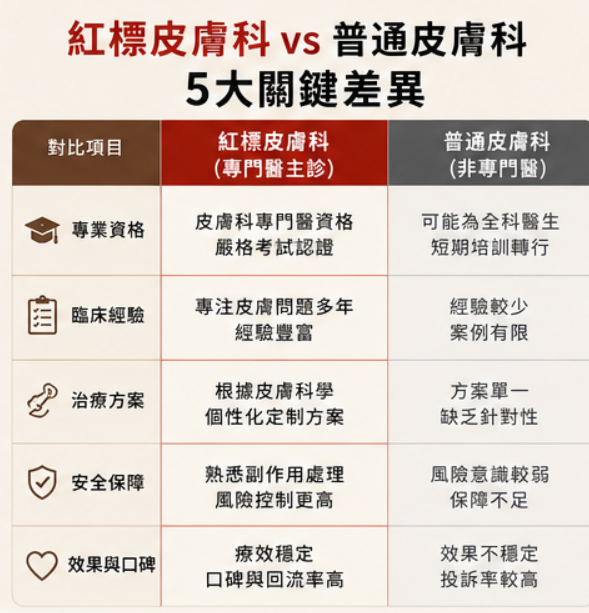
III. Practical differences: treatment approaches, complications, and aesthetics—three key aspects
The difference in years of training ultimately comes down to “hands-on experience.” These are the three things ordinary people can notice most clearly:
First is the approach to using energy-based devices. For machines like Thermage, HIFU, and Pico, how parameters are adjusted, to what depth treatment is applied, and how the treatment sessions are distributed all directly affect both the results and safety. Doctors trained by Redmark have a better understanding of skin layers and contraindications due to their systematic training; whereas regular clinics that rely only on a few days of manufacturer-led training tend to follow preset protocols, struggling when faced with special skin types.
Second is complication management. Medical aesthetics isn’t risk-free—blistering, hyperpigmentation, and allergies can all occur. Board-certified doctors with backgrounds in dermatopathology and emergency care know how to diagnose and treat these issues; this is especially crucial when it comes to determining who’s responsible in case of complications.
Third is aesthetic judgment. This is a matter of personal preference—red badges indicate medical expertise, but they don’t guarantee that the aesthetic results will suit you. Some doctors at regular clinics have excellent aesthetic sense and produce stunning results. Therefore, whether the outcome looks good or not can’t be determined solely by red badges; case studies are still necessary to make an assessment.
IV. Price and Services: Red-marked options are usually more expensive, but is the price justified?
To be honest, the prices at premium-rated clinics are generally on the higher side. For the same Rejuran treatment or the same Thermage device, these clinics might charge 20% to 50% more than regular clinics. What drives up the costs? Part of it is the premium associated with the doctors’ experience, while another factor is the clinic’s premium positioning—private treatment rooms, imported equipment, and translation services.
But high prices don’t necessarily mean it’s “worth it.” If you’re just looking for basic hydrating treatments or simple acne solutions, an ordinary clinic with a doctor who has solid experience and transparent pricing might actually offer better value. It’s only for complex issues—like persistent pigmentation, acne scars, sensitive skin, or anti-aging needs—that top-tier expertise becomes truly essential. So what’s the difference between premium Dermatology clinics in South Korea and regular dermatology clinics? In terms of price, it comes down to “premium overcharge vs. reasonable cost” — it’s not about the higher price being always better; it depends on which category fits your needs.

V. Instant Judgment: How to tell if a clinic is a top-rated one or just ordinary?
No need to be a medical detective—just three steps will do:
Method 1: Check the sign at the entrance. Clinics marked with a red sign will have a red “Dermatology Specialist” badge at the entrance; if there’s no such sign (no matter how nice the facility looks), it’s advisable to think twice before entering.
Method 2: Check the official website to see their experience. Reputable clinics with a red badge will definitely indicate that the director is a “dermatology specialist.” Be cautious if they don’t even dare to put that label.
Method 3: Verify on AKD’s official website. Log in to the website of the Korean Association of Dermatologists, enter the name of the hospital or director, and check whether it’s certified—this is the most authoritative method, making fraud difficult.
Pro tip: If a business’s name ends in “Dermatology,” it’s usually a specialized dermatology clinic, while those ending in “Clinic” are typically general beauty clinics. This trick can help you rule out most irrelevant options right away.

VI. Neutral reminder: Red labels aren’t a panacea, nor should ordinary products be dismissed outright.
After discussing the differences, it’s worth being a bit realistic. What’s the difference between a dermatology clinic in South Korea with a red label and an ordinary dermatology clinic? At its core, it lies in the difference in qualification requirements, which doesn’t mean that a clinic with a red label is necessarily the best fit for you.
First, clinics with the red label tend to charge higher prices, so those with limited budgets might feel the cost-performance ratio isn’t worth it. Second, just because a clinic has the red label doesn’t guarantee smooth communication or aesthetic results that match your preferences—clinical experience, recent case studies, and post-surgery follow-up are still crucial factors. Third, some regular clinics have highly experienced doctors who provide excellent service, but they haven’t obtained certification. Thus, the red label is a “plus factor” rather than the “only standard”—your skin type, budget, and schedule are what ultimately determine your choice.

VII. Use BeautsGO to check qualifications and book appointments – done in just 5 steps
If you want to check whether a clinic has red flags, verify the qualifications of its specialists, and make appointments, BeautsGO is the easiest way. The platform clearly indicates which doctors at a hospital are qualified specialists, so you don’t need to search through Korean-language websites yourself.
STEP 1: Download the app, or search for the mini-program on
WeChat—look for “BeautsGO” on iOS/Android, or scroll down in WeChat to find the “BeautsGO 彼此美” mini-program, which requires no download.
STEP 2: Search for the clinic name.
You can find it using “Lumiin”/“LUMIIN”, “CNP”, or “Alive”. You can also use their pinyin abbreviations to locate them directly.
STEP 3:Look for the “Board-Certified Physician” tag to visit the clinic’s
page, check the director’s qualifications and red-badge certifications, to confirm they are indeed board-certified physicians.
STEP 4: Select an item to see the real-time price. All prices are displa
yed instantly, with identical rates for both Chinese and Korean visitors—no need to worry about tourist surcharges.
STEP 5: Select a time slot + upload passport. Foreign guests are requir
ed to upload their passports, and they will receive a confirmation message within about 1 hour after submission.
VIII. Related Recommendations | These articles might also be helpful to you
If you’re still hesitating between choosing a top-rated clinic and a regular one, or have doubts about specialist doctors, the following article can provide additional insights:
- What does “Red Label” in South Korea’s Dermatology mean? A comprehensive guide to certified specialists, how to check them, and the differences from regular doctors — This article explains in detail what the Red Label is and how to verify it; it’s highly recommended to read it first.
- 2026 List of Top-Ranked Dermatology Clinics in South Korea|Lumiin, CNP, and Alive Are All Included! Only 2% of specialists across the country hold this prestigious rating! — This article provides a comprehensive comparison to help you decide which of these three top clinics to choose.
- How to make an appointment at Pria Dermatology in South Korea? Get a complete guide to the booking process via the BeautsGO APP in Chinese plus detailed cost breakdown — Learn how to choose the best booking method and what to expect in terms of prices with these step-by-step instructions.
- Can you visit Cellin Dermatology in South Korea without making an appointment? It’s not recommended. Appointments are required, as it’s very likely you won’t have a slot if you show up unannounced — why do almost all popular clinics in South Korea operate on an appointment basis?
- Is Pria Dermatology in South Korea a mass-production clinic? The service is top-notch—there’s not only a Chinese-speaking director who accompanies you throughout the process, but the consultation plan is also tailored exclusively for you. So how can you tell if a clinic is operating on a mass-production basis and whether its service quality is truly excellent?
- Don’t fall for inflated prices promoted by internet influencers! The 2026 updated real fee list from Cellin Dermatology in Hongdae (including prices for Ulthrea, Rejuran, Potenza, and RE2O collagen filler) — Learn how to spot transparent pricing and avoid misleading tactics used by influencers.
Final note: The red line is the bottom threshold, not the ceiling.
Returning to the initial question—what’s the difference between certified Dermatology clinics in South Korea and regular dermatology clinics? In short: certified clinics have doctors who have completed 11 years of specialized training; whereas doctors at regular clinics may have switched from other medical fields or focus only on basic skincare treatments. The differences in training, treatment approaches, and management of complications are significant, which is exactly why there’s such a big gap between them.
But don’t let the red badge fool you, nor assume that something being ordinary means it’s necessarily inferior. The red badge represents a “minimum standard guarantee,” not a “result guarantee.” Head to BeautsGO to check their qualifications, compare prices, read some genuine reviews, and then consider your skin type and budget—this will be more useful than reading a hundred ads. Wishing you a smooth trip to Korea and a successful transformation without any mishaps!