 By 變美體驗官
Many people who plan to undergo dermatological treatments in South Korea come across terms such as “Red-Label Dermatology” or “Specialized Dermatologists.” This often leads to questions: What exactly does the “Red-Label” designation in South Korean dermatology mean? Does it necessarily indicate higher safety? Below, we will provide a comprehensive explanation of the meaning of the Red-Label designation, the specialized doctor certification system, the official methods for verifying this status, and the differences between Red-Label and regular dermatologists, to help those visiting South Korea for medical aesthetics treatments for the first time understand these concepts quickly.
Next, let me take you through:
- What does the red mark in Dermatology in South Korea represent?
- South Korea’s Dermatology Specialist Certification Program
- How to check whether a doctor holds the necessary professional qualifications
- What are the differences between specialized medicine and general practice?
- How to choose a Dermatology department for your first medical beauty treatment in Korea
If you are considering going to South Korea for cosmetic surgery and want to reduce the risk of encountering problems, it is recommended that you first familiarize yourself with this basic information before making an appointment and scheduling your treatment.

I. What does the “Red Label” in South Korea’s Dermatology field mean? It is nothing less than an “honorary medal” for specialist doctors!
When going to South Korea for dermatology treatments, what people fear most is encountering a “wolf in sheep’s clothing” – a clinic with fancy decor but whose attending doctor actually has no formal training in Dermatology. Therefore, understanding what the red label in South Korean dermatology clinics signifies is the first thing you need to do. In this section, we will break down in detail why this red label carries such significant weight.
1. Represents a physician with specialized qualifications in Dermatology
In South Korea, not all physicians who are capable of performing laser treatments, hyaluronic acid injections, or other cosmetic procedures are specialized in Dermatology.
A true specialist in Dermatology must first complete their medical education and obtain a doctor’s license. After that, they must undergo several years of training as a resident physician in Dermatology and pass specialized certification exams before officially earning the title of specialist in this field.
Therefore, the primary significance of the red label is not to indicate that a clinic is of higher quality, but rather that the doctor has received comprehensive specialized training in Dermatology.
2. The phrase “ten years of hard work to sharpen a sword” behind the red label
Why is it said that only by choosing a doctor with a red label can one feel at ease? Because the production cost for a doctor with a red label is simply too high.
- Time cost: 6 years at medical school + 1 year of internship + 4 years as a specialized resident in Dermatology. During these 11 years, they devoted themselves to studying that thin layer of skin. Compared to general practitioners who start using lasers after attending just a weekend training course, specialized doctors have a much deeper understanding of the different layers of the skin, its anatomical structure, and how to manage related complications. Their knowledge is truly superior in every aspect.
- Professional expertise: Doctors specializing in Double eyelid surgery only focus on skin treatments. They won’t perform hyaluronic acid injections for you one day and then proceed with Breast Augmentation or Double eyelid surgery the next. This dedication to a specific area of expertise ensures their precise control over laser energy.
3. Where are red marks in Dermatology commonly found in South Korea?
Generally speaking, you can check the following sources:
- Entrance or signboard of the clinic
- The hospital’s official website
- Doctor Profile Page
- Some clinics display their relevant certification in the waiting area.
If you are unsure, you can also simply ask whether the clinic is staffed by a specialist in Dermatology.
4. Why has the “red label” become so popular online these days?
In the past, people went to South Korea for cosmetic procedures on a trial-and-error basis, but now, our sisters are much more informed and cautious.
- Avoid the “assembly-line model”: Many low-price online celebrity stores are actually run by ordinary doctors, focusing on providing cheap and quick services.
- Pursuing natural beauty: Doctors at Red Label place greater emphasis on the skin’s barrier function and long-lasting aesthetic results; they avoid excessive procedures that may achieve short-term effects but could harm the skin in the long run. This approach, characterized by a high level of professionalism, aligns perfectly with today’s aesthetic trend towards achieving a “natural, unaltered look”.

II. What does the certification of a specialist in Dermatology from South Korea mean?
In South Korea, the fact that a doctor has obtained a license does not necessarily mean that they are a specialist in Dermatology.
A true specialist in Dermatology must undergo comprehensive and rigorous specialized training; as a result, they typically possess extensive clinical experience in the diagnosis of skin diseases, laser treatments, pigmentation issues, the management of sensitive skin, and anti-aging therapies.
1. What are the requirements for obtaining a specialization in Dermatology?
Generally speaking, the following steps need to be completed:
- Completed medical school education
- Pass the National Medical Licensing Examination in South Korea
- Complete the residency training in Dermatology
- Pass the specialized qualification examination for Dermatology professionals
- Continuously pursue education through relevant professional associations
Therefore, the qualification of a specialist in Dermatology is based on extensive specialized training, rather than being obtained through short-term courses.
2. What types of treatments are specialized doctors particularly skilled in?
In addition to treating skin diseases, Dermatology specialists often perform various medical cosmetic procedures, such as:
- Pico laser
- Potenza
- Hydrofiller injections
- Rejuran
- Thermage
- HIFU
- Treatment for acne scars and Pores
- Improvement of pigmented spots and liver spots
Different doctors may have different areas of expertise, so it is recommended to find out about the treatments a doctor specializes in before making an appointment, rather than simply relying on the reputation of the clinic.
I don’t know which clinic to start consulting with…
On BeautsGO, you can simply search for “Gangnam Dermatology” or “Cheongdam Dermatology”. The treatment options, prices, and reviews for each clinic are clearly displayed. It’s recommended to use the app to narrow down your choices to 2-3 clinics before making an appointment for a consultation, thus saving you a lot of time running around 👇
👉 Use BeautsGO to search for Dermatology clinics and schedule consultations directly.

III. Does a red label necessarily mean that a Dermatology clinic in South Korea is better?
The answer is not necessarily definite, but it can serve as an important reference.
A red mark indicates that a doctor holds specialized qualifications in Dermatology; however, the absence of such a mark does not necessarily mean that medical institutions without it are not professional.
For example:
- Dermatology Center of the University Affiliated Hospital
- Dermatology Department of a General Hospital
- Some plastic surgery clinics
Skin treatment services may also be provided by experienced physicians.
Therefore, when choosing a Dermatology clinic in South Korea, it is recommended that in addition to verifying whether the practitioner is a specialist, you also assess the following aspects:
- Doctors’ clinical experience
- Whether to disclose the doctor’s background
- Is a comprehensive pre-operative assessment provided?
- Is there any post-operative follow-up service available?
- Are there any treatment cases that match my specific needs?
By taking all these factors into consideration, it is usually much easier to find a clinic that suits you than simply focusing on whether there are any red flags.

IV. Differences between specialized Dermatology doctors and general practitioners in South Korea: The gap may be more than just the use of one or two types of lasers.
Now that we understand what the red sign in Dermatology clinics in South Korea means, it’s time to delve deeper into the differences between specialized doctors (whose clinics have a red sign) and general practitioners (whose clinics do not).
| Comparison Items | Dermatology specialist | General medicine |
|---|---|---|
| Have you completed specialized training in Dermatology? | ✔ | Not necessarily. |
| Whether one possesses professional qualifications in Dermatology | ✔ | ✘ |
| Diagnosis of skin diseases | More comprehensive | It depends on an individual’s background. |
| Experience in laser and pigment treatment | Generally, it is more abundant. | This may vary depending on clinical experience. |
| Is it possible to undergo cosmetic procedures? | ✔ | Some of them can. |
It’s important to note that the fact that a doctor is general practice does not necessarily mean that their medical skills are poor. Some doctors have dedicated themselves to the field of cosmetic medicine for many years and have accumulated considerable experience. Therefore, we cannot judge the quality of their medical care solely based on whether they specialize in this area. Instead, we should consider the doctor’s background, treatment cases, and clinical experience when evaluating their competence.
A huge gap in diagnostic capabilities
An ordinary doctor might simply prescribe the right treatment based on your needs: if you want to undergo Pico treatment, they will help you do so. However, a specialist in this field will first determine the type of spots you have—whether they are chloasma or freckles. If you have sensitive skin, they might even advise against it. The expertise of a specialist can help you avoid many risks that could lead to permanent damage to your skin.
2. Mastering the precise control over machine operations
Even when using the same Thermage or Pico device, the results can vary significantly depending on who operates it. Specialist doctors have mastered the control of energy levels through tens of thousands of clinical cases; they know exactly at what depth and with how many treatments the best results can be achieved, thus preventing burns or unwanted dark spots.
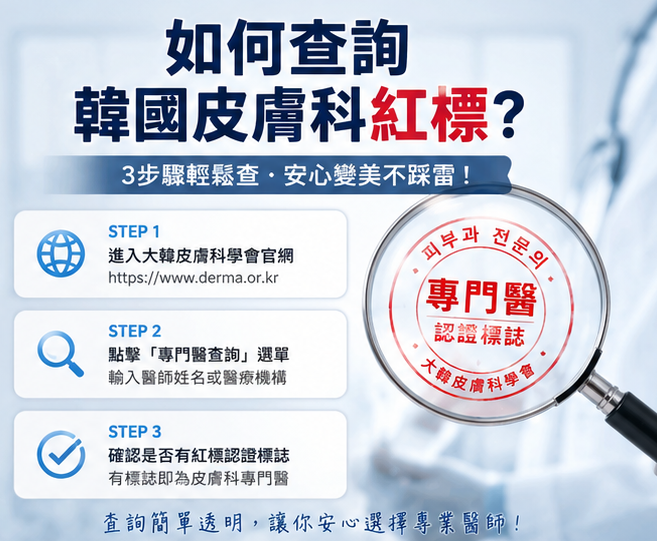
V. How to check for the red-label certification in Dermatology in South Korea?
If you’re concerned about encountering clinics with opaque information, there are actually several ways you can verify a doctor’s qualifications on your own.
Method 1: Check the clinic’s signboard
Clinics with professional qualifications in Dermatology will usually display relevant information regarding this specialty on their signboards, at the entrance, or inside the premises.
If you see the name “○○ Dermatology” or related indicators indicating specialized medical expertise, you can further check the doctor’s profile to verify their qualifications.
Method 2: Check the official website of the hospital.
Most Dermatology clinics in South Korea will provide information about their physicians’ backgrounds on their official websites, including the following details:
- Education background
- Specialized medical qualifications
- Members of the association
- Clinical experience
- Skilled in various treatment procedures
If the official website contains no information about the doctors, it is recommended to verify this in detail before making an appointment.
Method 3: Consult the Korean Dermatology Physicians Association
If you wish to confirm this further, you can visit the official website of the **Korean Dermatology Physicians Association (AKD)** and search for the doctor’s name or the name of the clinic.
If relevant information can be found, it usually indicates that the doctor holds professional qualifications in Dermatology.
Method 4: Check Naver Map and Google Maps
In addition to official information, you can also use the BeautsGO APP to view recent reviews.
It is recommended not to focus solely on the BYUL rating, but rather to pay attention to the following factors:
- Was it mentioned that the doctor would conduct a personal consultation?
- Is it necessary to explain the treatment process?
- Would you like to share your recovery progress?
- Whether to mention postoperative follow-up
Such information is usually more valuable than a simple five-star rating.
I don’t know which clinic to start consulting with…
On BeautsGO, you can simply search for “Gangnam Dermatology” or “Cheongdam Dermatology”. The treatment options, prices, and reviews for each clinic are clearly displayed. It’s recommended to use the app to narrow down your choices to 2-3 clinics before making an appointment for a consultation, thus saving you a lot of time running around 👇
👉 Use BeautsGO to search for Dermatology clinics and schedule consultations directly.
VI. For those going to Korea for medical beauty treatments for the first time, how should one choose a Dermatology clinic?
When going to South Korea for cosmetic procedures for the first time, many people tend to focus solely on prices. However, what is actually more important is to ensure that the clinic meets their specific needs.
It is recommended to evaluate the situation following these steps:
Step 1: Determine whether it is a specialist in Dermatology
First, find out whether the clinic discloses the background of its doctors and whether they possess specialized qualifications in Dermatology.
Step 2: Understand which treatments the doctor specializes in.
Different doctors have different areas of expertise; some specialize in anti-aging and lifting treatments, while others focus on treating acne scars, pigmentation issues, or sensitive skin.
If your goal is to improve the condition of your Pores or liver spots, it is recommended that you seek out a doctor with extensive experience in these areas.
Step 3: Review recent cases
In addition to the official case studies, you can also refer to recent testimonials from patients to understand the recovery time, treatment experiences, and whether the results meet your expectations.
Step 4: Confirm the details and costs of the treatment plan
It is recommended to confirm the following before making a reservation:
- Is the procedure performed personally by a doctor?
- Does it include postoperative restoration?
- Is a follow-up appointment necessary?
- Are there any additional fees or charges?
It is far more important to fully understand the details of a treatment plan than merely comparing prices.

VII. Which Dermatology clinics in South Korea are the best? Keep these “hidden gems” in mind!
Now that we know how to identify these top-quality establishments, let’s take a look specifically at Gangnam and Myeongdong – which shops are truly the leaders in this field?
Lumiin Dermatology: The pinnacle of natural anti-aging treatments
This shop is extremely popular among the local elite circles in South Korea.
- Advantages: The director is a typical specialist with advanced aesthetic skills. If you are seeking a natural and virtually imperceptible way to look younger, the customized treatment plans offered here will definitely meet your expectations.
2. galleria Dermatology: The savior for acne and Pores problems
For those with problematic skin, galleria is the first choice for many South Korean students.
- Advantages: It is particularly gentle when dealing with acne scars and marks. The procedures performed by specialist doctors are precise, and the recovery period is relatively short.
3. Alive Dermatology: The “boutique” in Gangnam District
This store may not be the largest in terms of size, but it certainly exudes the strongest sense of professionalism.
- Advantages: The director personally handles all consultations, and the consultation time is quite lengthy. If you’re tired of the 3-minute quick consultations at chain clinics, come to Alive and experience what true professional medical care really means.
4. CNP Dermatology: A well-established chain with professional credibility
CNP is very well-known in South Korea and has numerous branches.
- Advantages: As a specialized medical brand with a long history, their processes are highly standardized, and the skincare products they develop are also well-known. When it comes to CNP, the key selling point is undoubtedly their “brand credibility”.
I don’t know which clinic to start consulting with…
On BeautsGO, you can simply search for “Gangnam Dermatology” or “Cheongdam Dermatology”. The treatment options, prices, and reviews for each clinic are clearly displayed. It’s recommended to use the app to narrow down your choices to 2-3 clinics before making an appointment for a consultation, thus saving you a lot of time running around 👇
👉 Use BeautsGO to search for Dermatology clinics and schedule consultations directly.
VIII. Frequently Asked Questions
Q1: Can red labels from Dermatology clinics in South Korea be fake?
It is recommended not to rely solely on the signs at the entrance; you can also verify the information by checking the official hospital websites, doctor profiles, and the Korean Dermatology Doctors Association information provided through the BeautsGO app.
Q2: If there’s no red mark, does that mean I absolutely can’t go?
Not necessarily. Some university hospitals, general hospitals, or plastic surgery departments may also offer skin treatment services by experienced physicians. It is recommended to carefully evaluate the background and treatment experience of these physicians.
Q3: For which treatments is it generally recommended to consult a specialist in Dermatology?
For treatments such as Thermage, HIFU, Pico laser, Fraxel laser, hyaluronic acid injections, and Rejuran, which involve energy settings or skin condition assessments, it is recommended that they be evaluated by a physician with relevant experience.
Q4: How do South Koreans find a Dermatology clinic on their own?
Many South Koreans tend to refer to NAVER Map, hospital official websites, and information about doctors’ backgrounds when making decisions, rather than simply relying on prices or recommendations from social media platforms.
Understanding the significance of the red label in Dermatology in South Korea can help those going for medical beauty treatments in South Korea for the first time to more effectively select clinics. However, the red label indicates the professional qualification in Dermatology and is not the only criterion for assessing the quality of medical services.
It is recommended that before making an appointment, you also verify the doctor’s background, clinical experience, the details of the treatment plan, the facilities available, and the post-treatment services. Only then can you choose a Dermatology clinic that suits your skin condition and needs. Doing some additional research in advance is usually more beneficial than simply pursuing low prices, as it will help you ensure that you receive the treatment experience you expect.
