 By 變美體驗官
Before going to South Korea for medical beauty treatments, many people’s biggest concern isn’t the language barrier, but rather “Why is the price for the same procedure so different from what others are charging?” MeiFill Dermatology has been getting a lot of inquiries lately, especially regarding services like the Ulthrea, Thermage for the eye area, and thread lifting—and indeed, their prices are significantly lower than those of many other clinics.
I. Overview of the Latest Price List at MeiFill Dermatology in South Korea: Hyaluronic Acid Fillers, Photorejuvenation, and Thread Lifts – All in One Place
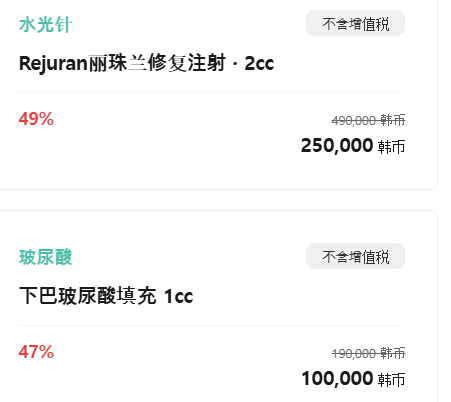
The prices listed below are taken from recent actual screenshots and are marked as “excluding VAT.” To get straight to the point: these are listed prices only, with a 10% VAT added to the final bill. Foreign tourists can claim a tax refund upon departure, but the exact refund rate and requirements need to be confirmed on site. The exchange rate used here is temporarily set at 10,000 Korean won ≈ 53 RMB; the actual rate will be based on that day’s credit card transaction rate.
| Categories | Project Name | Price (KRW) | Approximately RMB |
|---|---|---|---|
| Hydrating treatments / injections | Rejuran Repair Injection: 2 centum core | 250,000 | Around ¥1,325 |
| Hydrating treatment / Injection therapy | Chin Filler Injection: 1 centum core | 100,000 | Around ¥530 |
| Photorejuvenation/Lifting | Ultherapy PRIME: US Version Ultrasound Lifting – 100 Sessions | 350,000 | Around ¥1,855 |
| Photorejuvenation/Lifting | Thermage Eye Treatment at 225 joules | 900,000 | Around ¥4,770 |
| Phototherapy/Brightening | 1 Session of Pico Skin Purification | 50,000 | Around ¥265 |
| Thread Lifting / Tightening | Full-face thread Lifting with 15 threads | 900,000 | Approx. ¥4,770 |
A quick glance at the table reveals several patterns: dermal fillers and Pico treatments fall into the entry-level category, with low prices but usually requiring multiple sessions; the Ulthrea 100 and Thermage for the eye area sit in the mid-range for photonic treatments; whereas full-face thread lifting with 15 threads is a procedure with a high single-session cost. At first glance, the prices might seem “much cheaper than those in China,” but the three facts we’ll discuss next will help you reassess the overall cost.
Second, is “same price in China and South Korea” true? Let’s clarify three facts first.
1. VAT is not included; an additional charge will appear at checkout.
Almost every item in the screenshot is marked as “excluding VAT.” It’s common practice at medical beauty clinics in South Korea to list the price before tax first to make the figures look more attractive, but a 10% VAT is added at checkout.
In other words, that bottle of Rejuran priced at 250,000 won actually costs 275,000 won; the 100-session Ulthrea package is 350,000 won, which rises to 385,000 won after taxes. Although foreigners can get a tax refund, it’s usually processed at the airport or designated refund centers, rather than being deducted on the spot. Moreover, some clinics have a minimum spending threshold for issuing refunds.
So there’s usually a gap of around 10% between the “price shown” and the “actual cash spent” at the end.
2. “Same price in China and South Korea” means “identical pricing,” not “identical service content.”
Many clinics advertise “same price for Koreans and foreigners,” meaning that both locals and international clients see the same price list, with no extra charge just because you speak Chinese. This practice has become increasingly common in Gangnam, South Korea, thanks to fierce competition and transparent pricing—making it easy to expose any unfair surcharges. However, “same price” doesn’t necessarily mean “same treatment plan.”
Even with the Ulthrea, there’s a huge difference between 100 shots and 300 shots. Similarly, for thread lifting, 15 threads versus 30 threads result in vastly different effects and duration of results.
Some low-cost packages use fewer injections or threads to keep costs down, but the actual appropriate number of injections should be determined in person by a doctor.
So rather than asking “Is it true that the prices are the same in China and South Korea?” it’s better to ask “Are the number of hairs, thread count, and machine model corresponding to this price the solution I need?”
3. Low prices are often tied to specific models or certain conditions
The names on the price list—Ultherapy PRIME, Thermage, and Pico—seem like familiar devices, but there are differences among them in terms of generation, probes, and pulse counts.
For example, Ultherapy PRIME represents the next generation, offering different levels of energy and comfort compared to the previous model. Thermage’s eye treatment probes also come in various versions. If someone at the clinic tells you that “this discounted price is only available with the older probe” or “100 sessions can only be used for one treatment area,” then that listed price is merely a tactic to attract customers, leaving plenty of room for additional charges later on.
It’s recommended to clarify all details such as the “model, probe, number of pulses, number of wires, whether tax is included, and whether a refund is possible” at the time of booking. It’s best to take screenshots as proof.
4. Exchange rates and card transaction fees also eat into part of the price difference
Even if you get a price identical to that of locals in South Korea, there are still two hidden costs at checkout: exchange rates and card transaction fees. Using a foreign currency credit card typically incurs an international transaction fee of around 1.5%, with some banks adding on a DCC dynamic currency conversion fee as well.
If you pay in RMB directly, the exchange rate is often quite different from the market midpoint. In other words, the same price listed for products in China and South Korea is only a starting point—the actual total cost you end up paying includes an additional fee.
For those on a tight budget, it’s recommended to check in advance which credit cards the clinic accepts, whether cash in Korean won is usable, or to lock in the price including taxes through a Chinese booking platform like BeautsGO first.
III. Four things you must confirm before booking—don’t let price be the only factor that influences your decision
- Tax included or not: Start by asking, “Is this the final price? Or is it before tax?” Ask them to provide the total amount including taxes to avoid any surprise at checkout.
- Number of shots/threads/areas: For photorejuvenation treatments, make sure to clarify “how many shots in total and which areas will be treated.” For thread lifting, ask about “the total number of threads, whether they are absorbable, and which areas will be lifted.” For injections, inquire about the “brand, dosage, and duration of effect.”
- Machine model and probe version: For example, Ultherapy PRIME or Thermage FLX compared to the older versions, and whether the probe is brand new and unopened at the time of use. The machine model can affect both the treatment results and level of discomfort.
- Cancellation and rescheduling policies: Many clinics in South Korea charge a fee for last-minute cancellations, especially for treatments like Thermage and Ulthrea that require advance preparation of specialized probes. Make sure to check the rules before scheduling your appointment to keep things more flexible.
V. Who is MeiFill Dermatology suitable for? And who should avoid it?
In terms of price, MeiFill is more suitable for those who want to quickly compare prices, have a clear idea of the procedures they’re interested in, and have already done their research.
For example, if you’ve already decided to get Thermage treatment around the eyes, or if you’ve had Pico treatments and want to schedule follow-up sessions, in such cases the price list serves as a transparent reference that you can use to compare options directly.
But if you haven’t thought it through and just want to “go in and ask around,” you might end up being sold a package deal.
Clinics in South Korea have a fast pace with short consultation times, making it easy to be swayed on the spot.
It’s recommended to make a list of the questions you want to ask before going, or even show the consultant the table from this article and ask, “Is this price still available? Is this the correct number of units?”
What doesn’t work is the mindset of placing an order just based on the lowest price.
Medical aesthetics isn’t about buying cosmetics. Whether the treatment plan is appropriate and whether the doctor provides thorough evaluation are far more important than saving a few hundred dollars. If, during the consultation, the provider keeps avoiding details such as the number of injections, threads, or devices used, while insisting that “you won’t get any discount if you don’t buy today,” then such behavior should definitely raise red flags.
True transparency in offering the same prices for Korea and China means clearly outlining the price, services, and terms—rather than luring people in with low prices first.
VI. Conclusion: Understanding the price list is more important than securing a low price
Overall, MeiFill’s pricing structure is quite transparent. At least the screenshot clearly states that “VAT is not included,” and it also lists the exact number of injections and dosage. However, whether a service is overpriced or not isn’t determined by just one price point—it depends on whether you feel respected throughout the consultation and quotation process, and whether you have access to all relevant information. It’s possible for prices to be the same in South Korea and China, but only if there’s “the same listed price + clear treatment plan + no hidden fees.” Save a copy of this price table before you go, and check each item carefully when making an appointment—this is the best way to avoid getting overcharged.
If you haven’t yet read the articles on the reservation process and transportation tips for the Ulthrea, it’s recommended to check them side by side to get all the details—such as the address, operating hours, and reservation methods—clear at once.
Additionally, articles such as an in-depth price breakdown of the Potenza used in South Korea, guidance on choosing between Sofwave and Ulthrea, information on whether injectables from South Korea can be brought back to home countries, a must-read guide before booking a Cleor treatment, tips for scheduling appointments at Forever in Myeongdong, and a collection of addresses for btskin in Jeju are all valuable references for those exploring this same field. Reading a few of these articles before you go will give you more confidence.
Disclaimer: The prices and details mentioned in this article are based on screenshots provided by users and public information, and are intended solely for reference. There are individual differences and associated risks associated with cosmetic procedures. For accurate pricing, device models, number of treatments, and available options, please consult MeiFill Dermatology in person or check the official BeautsGO website. Before making any purchase, be sure to fully understand the procedure details, post-treatment care requirements, and cancellation policies to help you make an informed decision.