 By 變美體驗官
韓國醫美行程別亂排:一天能做幾個項目、哪些項目要錯開,一篇說清
This is even more crucial for sisters who are doing procedures abroad—language barriers, limited time spent there, and the need to return home for post-op follow-ups mean that if something goes wrong, there’s no chance to fix it. So rather than trying to do too much at once, it’s better to schedule procedures in a way that gives them enough time apart. Below, we’ll explain in simple terms exactly how many procedures can be done in a day, which ones need to be spaced out, and why.

I. Why a poorly planned medical beauty trip in South Korea can go wrong
Overall, the problem with scheduling procedures haphazardly is that “stimuli that should be spaced apart end up being done on the same day.” The consequences aren’t just extra costs — it often results in both poor outcomes and safety risks. Many people think, “It’s such a rare chance to travel abroad; I might as well get more procedures done to make it worth it,” only to return home with severe swelling that makes the trip a complete disappointment.
Especially for those traveling across borders, the swelling has to be endured for over ten hours on the plane, and changes in cabin pressure only make the discomfort worse—a point that guests departing from Taiwan and Hong Kong tend to overlook the most. Keep these three most common warning signs in mind before you set off:
- Redness and swelling compound, making recovery harder: When two procedures that both cause redness and swelling are scheduled on the same day, the swelling effects add up. It might not be noticeable right away, but it shows up the next day or even while flying, and ice packs won’t help reduce it.
- Combination of anesthesia and medications: If sedative anesthesia, topical anesthetics, and postoperative pain relief are used multiple times on the same day, the metabolic burden on the body increases. People with sensitive constitutions are more prone to dizziness and allergies, and it becomes harder to determine which factor caused the issues after surgery.
- Conflicts between treatment areas and layers: When the same face and the same layer are treated repeatedly, these overlapping areas can counteract each other’s effects. In mild cases, the results may not be noticeable, but in severe cases, unevenness and lumps can occur, requiring extra time for correction later on.
If you’re doing your homework and wondering “whether this clinic gives you enough time to make such a decision,” it’s better to first check out the educational information and booking guidelines they make publicly available—this way you’ll have a clear answer before even stepping inside. Go to BeautsGO to read about Dermatology in South Korea and learn how to schedule appointments ›
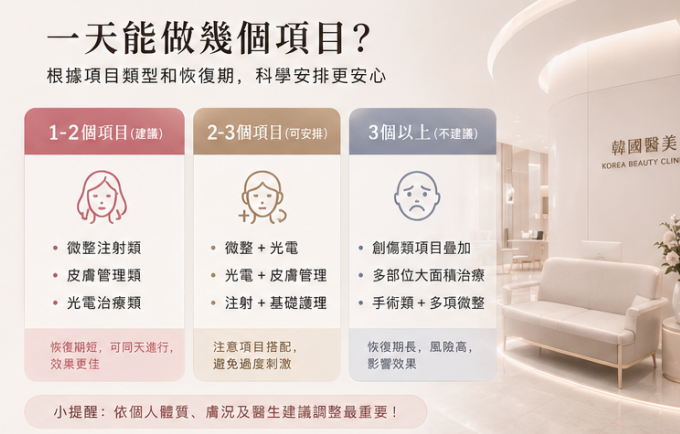
II. How many procedures can be done in a day?
Generally, 1–3 treatments per day is ideal, with “non-invasive procedures first, different treatment areas, and minimal recovery time” being the best approach. Those claiming to be able to fit in 5–6 treatments in a single day are usually just trying to maximize their schedule, not considering what’s best for your skin. As a side note: if a clinic insists on squeezing six procedures into one day, ask clearly whether it’s based on your skin condition or simply to optimize their workflow. To determine how many treatments can realistically be done, consider three factors:
- By level of invasiveness: Non-invasive treatments (micro-bubbles, soothing repairs, basic phototherapy) can be done 2–3 times on the same day without issue; invasive treatments (injections, skin ablation) should be limited to 1–2 sessions per day, with care taken to avoid treating the same area and not applying them multiple times to the same face.
- By body part: Treatments for the face and different areas of the body can be done simultaneously—such as facial care in the morning and leg care in the afternoon without interfering with each other. However, treatments for the same area should be spaced out to avoid repeated stimulation of the same skin layer.
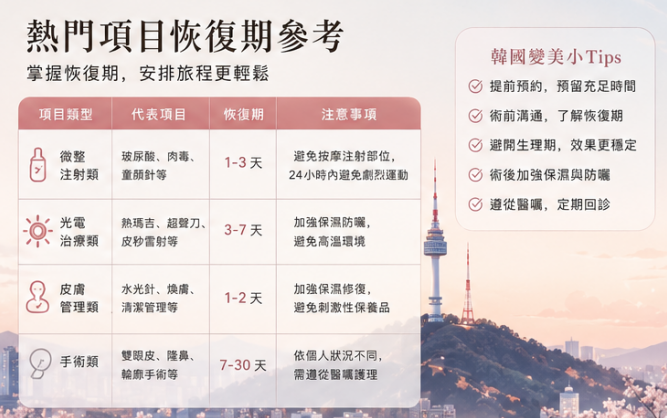
- By recovery time: If you need to meet someone on the same day or fly the next day, choose procedures with a shorter recovery period. For any procedure that causes swelling, leave some buffer time and avoid scheduling it the day before your departure—otherwise, you’ll suffer the most on the plane.
| Combo Type | Is it possible on the same day? | Notes |
|---|---|---|
| Tiny bubbles + soothing repair + photonic (non-invasive) treatment | On the same day | Recovery is mild — you can go out as usual on the same day. |
| Filler + Botox (for different areas) | On the same day | Inject in separate areas to avoid the same layer. |
| Microneedling + hyaluronic acid treatment (both fall under skin-penetrating therapies) | It’s recommended to stagger them. | Every 1–2 weeks, give the skin barrier time to recover. |
| HIFU/Laser + Filler Injection | It’s recommended to schedule them at different times. | Heat can affect setting; wait 1–2 weeks for better stability |
| General Anesthesia/Surgical Procedures | It must be done separately. | Leave space before and after, do not align with other items |
III. Which cosmetic procedures in South Korea should be spaced out?
The key point: There are three types of combinations that pose the greatest risk—try to avoid doing them every other day if you can. What they have in common is that “they all damage the skin barrier, either generate heat, or require the body to work hard to metabolize them.” Doing these together only doubles the risks, not the benefits. It’s not that these treatments will cause problems on their own, but rather that combining them significantly increases the risks—by giving enough time between treatments, the results will be even more noticeable. Let’s take a look at each type separately:
- For treatments that cause skin breakdown: microneedling, hyaluronic acid injections, chemical peels, and fractional lasers all compromise the skin barrier. It’s best to wait at least 1–2 weeks between them to give the stratum corneum and microvessels time to recover. Doing two such treatments in the same week can exacerbate redness and sensitivity.
- Performing photorejuvenation and injections on the same day: If you undergo laser treatment or HIFU followed by Filler or Botox on the same day, the heat can affect the setting of the fillers and double the risk of swelling. A safer approach is to complete the photorejuvenation first, wait 1–2 weeks before getting injections, or if doing it on the same day, make sure to separate the treatments between the upper and lower face areas to avoid treating the same region simultaneously.
- General anesthesia/surgical procedures: Any procedure that requires general anesthesia or larger incisions is scheduled on its own day, with time left before and after it to ensure it isn’t done simultaneously with other cosmetic treatments; these procedures have long recovery periods, and trying to cram them into the same schedule will only hinder each other.
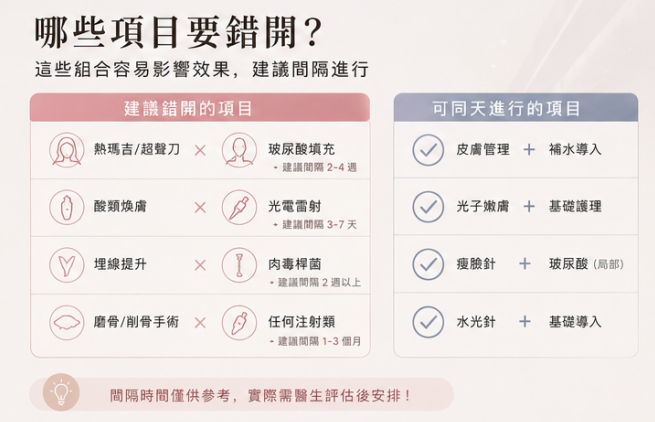
Before checking prices and schedules, compare them first to figure out which services warrant a buffer day and which can be easily done on the same day: Go to BeautsGO to view price ranges for various services ›
IV. How to Book Appointments for Medical Aesthetics in South Korea Smoothly
Just remember three steps: non-invasive preparation, invasive finishing, and buffer period. Following this order ensures that the procedures with milder recovery effects are done first, giving you time to observe reactions from those that require closer monitoring, with an extra day left for the skin to reduce redness. Another advantage of this sequence is that since the more invasive procedures are scheduled earlier, if any side effects occur after surgery, you’re still in South Korea and can go back to the clinic for consultation without having to reach out to customer service across the ocean. The three specific steps are:
- Non-invasive first, then invasive: Use micro-bubbles, soothing treatments, and reparative therapies in the morning to optimize skin condition; schedule injections and exfoliation in the afternoon or the next day, so that invasive procedures can be performed when the skin is in its best state, making it easier to observe results on the same day.
- Glow treatment in the morning, followed by recovery care in the afternoon: Since glow treatments are sensitive to sunlight, it’s best to complete the treatment in the morning and then do indoor recovery care in the afternoon before returning to the hotel to stay out of the sun. Avoid scheduling the glow treatment for evening—you’ll still need to be on your way before sunset, making it harder to take proper care of your skin.
- Leave buffer days: Start treatment the day after arriving in Korea, and focus only on recovery or non-invasive procedures 1–2 days before departure. Schedule any procedures that may cause swelling earlier; these 1–2 days give your body time to recover, so you won’t regret it once you’re on the plane.
V. Example Itinerary for a Cross-Border Trip of a Few Days
Overall, the number of days determines how much treatment you can fit in. Don’t try to cram 7 days’ worth of procedures into just 3 days—it will only turn your face into a laboratory. If you’re truly limited by time, it’s better to skip some treatments rather than shorten the intervals between them. It’s better to do fewer procedures properly than to ruin your face. The following three scheduling options are the most commonly used by international clients and carry the lowest risk of complications—match them to your length of stay:
- 3-Day Quick Flash Treatment: Day 1 – Arrival + soothing and repairing base treatment; Day 2 – 1–2 non-invasive or mild needle treatments (on different areas); Day 3 – Repairing treatment before returning home. The key is “less but targeted” treatments to avoid any swelling.
- 5-day standard protocol: Day 1 for recovery; Days 2–3 for invasive procedures performed on alternate days; Day 4 for phototherapy; Day 5 for final recovery before returning home. Separating invasive procedures from phototherapy with a one-day observation period in between is the most reliable approach.
- 7-day intensive treatment: initial invasive phase, mid-stage phototherapy, and final recovery phase, with at least 2 days between each stage, plus 2 buffer days throughout. Only with sufficient time can the “staggered” approach be fully implemented, allowing for the most accurate assessment of results.
VI. Common Q&A About Medical Aesthetics in South Korea
Finally, address the three most frequently asked questions all at once, in order, so you won’t feel rushed on the day of your appointment. For each answer, start with the conclusion first, then explain why.
Q1: Can you get a Filler injection and an HIFU treatment on the same day?
- It’s not recommended to do them on the same day: The heat generated by HIFU can affect the setting of Filler, making it difficult to assess the results if both treatments are performed at the same time.
- If you really want to do it on the same day, divide the area carefully: strictly separate the upper and lower halves of the face and avoid injecting in the same area to keep swelling risks under control.
- For better stability, wait 1–2 weeks: do phototherapy first followed by injection, giving time for the heat to subside and the filler to settle, so you can travel back home with peace of mind.
Q2: Can microneedling and hyaluronic acid treatments be done together?
- Both types of skin damage can cause swelling on the same day: since they both impair the skin barrier, swelling and redness will intensify when done together, leading to a longer recovery time.
- It’s recommended to wait 1–2 weeks: this gives your skin barrier time to recover, resulting in better and safer results on the second treatment.
- For sensitive skin, be more cautious: Those who are prone to allergies and have thin skin should wait 2–3 weeks between treatments for better results—don’t rush it.
Q3: Can I get injections the day before leaving?
- Not recommended: The injection area will swell on the day of treatment, and the pressure changes in the airplane the next day can make the swelling more noticeable and harder to manage.
- Allow time for swelling to subside: Schedule invasive procedures at least 2–3 days before departure to give time for redness to fade.
- Just for repair: On the last day, non-invasive treatments for soothing and repairing the skin are scheduled to keep your complexion stable upon departure.
After scheduling your appointment with one click, use the Chinese booking system that separates the “consultation” and “procedure” steps, so you won’t be rushed through everything. Go to BeautsGO for one-click appointment booking ›
Related Recommendations
- Guide to Making Appointments at Cellable153 Dermatology in South Korea: From how to schedule an appointment to what to bring for the consultation—everything you need is listed in detail
- Fly straight to South Korea for cosmetic treatments! Complete guide to booking at top Dermatology clinics in South Korea online—booking is available in Chinese too
- Complete Guide to Cellable153 Dermatology in South Korea: Location, Real Reviews, and Popular Treatments – All in One Article
- Is Cellable153 Dermatology in South Korea just a mass-production clinic? No way! The director provides personalized treatment for each patient and performs procedures in person, which is truly reassuring.
- What tier does Major Dermatology in South Korea fall into? Top-rated doctors on staff, yet surprisingly affordable prices
- Full price list revealed for Cellable153 Dermatology in South Korea! Clear pricing for HIFU, Rejuran, and Thermage
Disclaimer: This article provides general information on cosmetic surgery treatment plans and is intended solely for reference purposes. It does not constitute medical advice. Since everyone’s skin type, allergy history, and medication use vary, the specific treatment combinations, intervals between procedures, and suitability should be determined based on an in-person evaluation by a physician and his or her approval. Cross-border medical treatments involve various factors such as language barriers, refund policies, and post-operative follow-up, so be sure to clarify all these details before making a decision.
[…] · 韓國醫美行程別亂排:一天做幾個、哪些要錯開 […]