 By 變美體驗官
Many people only realize when they visit a Dermatology clinic in South Korea that the doctor treating them isn’t the one they saw online initially. This isn’t usually due to any deception, but rather because the scheduling and role allocation systems at medical beauty clinics in South Korea work differently from what people expect. To put it simply: while most clinics don’t assign doctors randomly, if you don’t specify your preference, you’ll be assigned to the doctor who’s available on that day. If you want to see a particular doctor, there are five things you must confirm beforehand—by the time you mention it on the day, it’s often too late.
• The clinic director isn’t always the best choice for a specific procedure—it depends on the treatment.
• “Consulted by the director” and “Performed by the director” are two different things.
• Making a preference usually requires booking 2–4 weeks in advance, and there may also be a fee for that request.
• Requesting a specific doctor on the day of the appointment has a very low success rate.

Let’s start with the conclusion: Dermatology doctors in South Korea aren’t assigned randomly—they go through a scheduling and role-division process.
There are two common approaches in Dermatology clinics in South Korea: one is the scheduling system, where patients are seen by whichever doctor is available on that day; the other is the dedicated physician system, where the same doctor handles everything from the initial consultation to post-operative care. Larger clinics more often adopt a division of labor approach, with different doctors responsible for the consultation, procedure, and post-operative management.
So that sense of “being assigned randomly” actually stems from a very simple reason: you don’t specify who you want, and the clinic naturally allocates patients based on its capacity for that day. It’s not arbitrary—it’s the result of an efficiency-driven approach.
There’s another reason that’s less often mentioned — clinics usually don’t proactively promote their directors. A director’s time is a precious resource; they can only see a limited number of patients in an hour. Clinics tend to reserve their directors for high-value procedures that require expert judgment, leaving routine, simpler treatments to the attending physicians. Once you understand this logic, it becomes clear that if you want to have a specific doctor handle your treatment, you need to take the initiative yourself, and the sooner you ask, the better your chances of success.
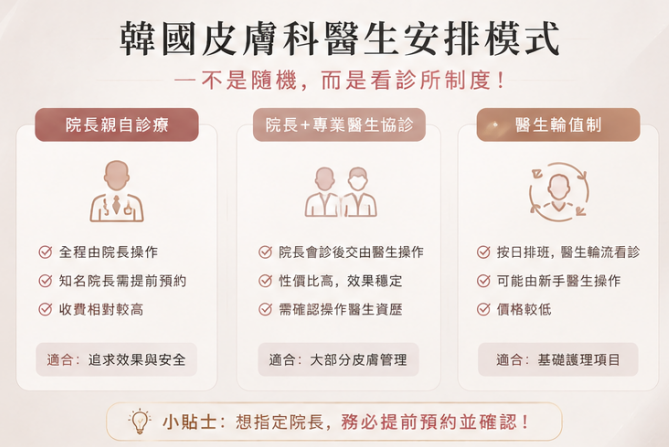
What’s the difference between the directors, specialist doctors, and treating physicians at Dermatology clinics in South Korea?
First, figure out the three types of roles in the clinic, so you can determine exactly who you want to assign to the task and whether it’s worth waiting an extra two weeks for them.
| 1 | Representative Director (원장): The head of the clinic, with the most extensive experience and judgment. Their expertise usually focuses on specific procedures such as thread lifting, lift therapy, and complex injections. They have the shortest availability and are the hardest to book, often requiring an additional referral fee. |
| 2 | Specialist Physician: A doctor who has passed the specialty exam and is able to see patients and perform procedures independently. They are the main practitioners for most treatments and typically have the highest CP value. |
| 3 | Surgeon/General Physician: Responsible for standardized procedures (laser treatments, management tasks), with proficient skills and high efficiency, ideal for minor procedures. |
(Incremental type: Data/Trends) In recent years, large medical clinics in the Gangnam area have become increasingly specialized, even adopting a standard workflow that separates “consulting doctors” from “performing doctors.” The advantage is higher efficiency and more predictable pricing; however, the risk is that you might assume the doctor who conducts the consultation will actually perform the procedure themselves, only to find that’s not the case. This is precisely where most people feel disappointed, and it’s also the key point we want to emphasize in this article.
• Chinese interface with translation options; you can add notes in Chinese for specific requests
• Check the doctor’s expertise and availability first before deciding whether to make a specific request
If you’d like to designate a specific director, make sure to confirm this 5 points in advance.
I recommend asking about all of the following 5 points before booking. If any of them aren’t confirmed, you might end up wondering, “Why isn’t it him?” on the day of the appointment.
| 1 | Does the director “perform the procedure personally”? It’s important to distinguish between “personal consultation by the director” and “the director performing the procedure himself”. A personal consultation simply means he examines you, while performing the procedure himself means he carries out the treatment himself. Make sure to ask about this when booking. |
| 2 | What are the director’s specialties? The director doesn’t handle every procedure. First, find out which procedures he specializes in—if your procedure isn’t within his expertise, it won’t be very useful to refer you to him. |
| 3 | How is the referral fee calculated? Find out exactly how much it is, whether it’s charged per visit or per procedure, and whether it can be applied toward the total cost—ask all these questions when making the appointment, rather than waiting to find out on the day. |
| 4 | How far in advance should I book? The director’s appointments usually require 2–4 weeks’ notice, and even longer during peak seasons. Trying to schedule at the last minute or just the day before has an extremely low chance of success. |
| 5 | Rules for rescheduling and cancellation: Most appointments with the clinic director require advance notice to be rescheduled. Last-minute cancellations may incur a fee, or it might not be possible to book back at the original time. |
The most reliable way is to clearly state in the notes section when booking on the platform: “I would like Dr. OO to perform the procedure personally. If the schedule doesn’t work, please let me know so we can reschedule,” and ask for a written response. Verbal promises are most likely to be misunderstood on the day of the appointment—only something in writing provides real protection and serves as a basis for any follow-up discussions.

比較項目指定院長不指定(排班)
| Who helped you do it | Specify the individual clearly | Doctors available that day |
| Difficulty in making appointments | Plan 2 to 4 weeks in advance | Appointments are available most weeks of the month |
| Costs | There might be a tip fee. | Usually no extra charge |
| Suitable Projects | Thread lifting, lifting procedures, complex injections, high cost | Laser, Management, Basic Skincare |
| Elasticity | Changing the appointment comes at a high cost. | Can be adjusted temporarily |
Four common misconceptions
| 1 | Myth 1: You can choose your preferred date just by paying. Once the clinic director’s schedule is full, it stays full—even with extra payment, you might not be able to get in. What really matters is booking in advance, not just having enough budget. |
| 2 | Myth #2: “Consulted by the director” means “Performed by the director.” These two phrases differ by just one word, but the outcome can be quite different. It’s the most common source of disappointment—the director does the consultation while someone else carries out the procedure. |
| 3 | Myth 3: Having a designated director is necessarily better. When the procedure doesn’t match the doctor’s expertise, a specialist is actually more skilled and cost-effective; the value of a director lies in their ability to make judgments and handle complex procedures. |

5 Steps for a Smooth Visit to a Dermatology Clinic in South Korea: Follow This Checklist
Break down this task into four specific time points — following this approach will help you avoid missing anything. The key is to “keep a record after each step,” rather than just making one phone call.
| 1 | 3–4 weeks before your appointment: First, check the director’s specialties and available slots. Use the platform’s notes to specify your preferences—the earlier you book, the better your chances of getting a slot. |
| 2 | Book now: Ask everything at once—“who will perform the procedure, how much is the name fee, and what are the rules for rescheduling”—and insist on a written reply instead of just verbal information. |
| 3 | 3 days before departure: Double-check the appointment time and doctor’s name, especially during peak seasons or before long holidays. |
| 4 | Check-in on the same day: Verify the name at check-in; if someone else is showing up, ask immediately for the reason and the qualifications of the replacement doctor. If you’re not satisfied, reschedule—don’t settle for half-measures. |
Many people think, “It’s a hassle to double-check,” but when it comes to specifying a doctor, going through the extra effort once is far easier to handle than realizing on the spot that it’s not the right person. Especially since you’ve taken a flight just for this, the time cost is much higher than sending a simple message.
• Chinese interface with translation options; you can add notes in Chinese for specific requests
• Check doctors’ specialties and availability first before deciding whether to make a reservation
6 Common Questions FAQ
Q: Can I request a specific director on the day of my appointment?
A: Usually not. Directors’ schedules are typically filled up well in advance, so trying to pick one on the spot is purely luck-based with a very low chance of success. If you want to specify a director, you need to arrange it during the booking process.
Q: How much is the name fee usually?
A: It varies greatly among different clinics — there’s no fixed standard. Fees range from a set amount to a percentage based on the service. It’s best to ask directly when making an appointment, and take the chance to confirm whether it can be deducted from your total bill.
Q: How can I make a request if I don’t speak Korean?
A:Using an appointment platform with a Chinese interface is the easiest way. Write in Chinese in the notes section specifying the doctor and procedure you’d like, and ask for a written confirmation. Most clinics in Gangnam have staff who speak Chinese and can help verify your request.
Q: Once a specific director is assigned, will they also be in charge of post-surgery care?
A: Not necessarily. Post-surgery care is usually provided by nurses or other doctors. So it’s important to clarify who will handle the follow-up visits after surgery as well, to avoid any significant discrepancies.
Q: Is it better to choose a clinic director or a specialist doctor?
A: It depends on the procedure. For high-demand procedures that require advanced skills such as thread lifting, lift surgery, or complex injections, it’s better to go with a clinic director. For standard, simpler treatments like laser therapy or skincare services, hiring a specialist doctor is more cost-effective.
Q: Is the doctor’s information displayed on the platform reliable?
A: It can serve as a preliminary reference, but the actual schedule for that day should still be based on what the clinic confirms. Double-checking the doctor’s name and availability before you go is the safest approach.
Q: What should I do if I find out at the clinic that it’s not the designated doctor?
A: First, find out why. If the substitute doctor has the necessary qualifications and expertise to meet your needs, you can go ahead with the treatment. If not, reschedule immediately—don’t end up on the treatment table under reluctant circumstances.
Q: Will choosing a specific doctor cost significantly more?
A: Usually, there’s an additional fee for selecting a particular doctor, but whether it’s worth it depends on the procedure. For high-cost treatments, paying a bit extra for expertise is often more worthwhile than saving money only to end up with reduced results.
7 Types of People Who Are Ideal for Designated Chief Physicians / Those Who Don’t Need to Be Stubborn
✅ Ideal for: those who opt for procedures like thread lifting, lifting treatments, or complex injections—services with high costs and difficulty levels; first-time clients looking for reliable results; those who are particularly sensitive to differences in outcomes; and those with flexible budgets and time constraints.
❌ No need to insist: Those who only want standard treatments like laser therapy and management services, those with short treatment durations that don’t allow booking 2–4 weeks in advance, or those with limited budgets who prefer to spend their money on the actual treatment—for these people, focusing on choosing the right clinic is more practical than specifying a particular doctor.
⚠️ Disclaimer: This article is intended to provide general information about the booking process and does not constitute medical advice. Doctor policies, appointment rules, and fees vary significantly among different clinics. Whether an appointment can be made and who will perform the procedure should be based on the clinic’s current guidelines; be sure to disclose your medical history and medications before the procedure.